
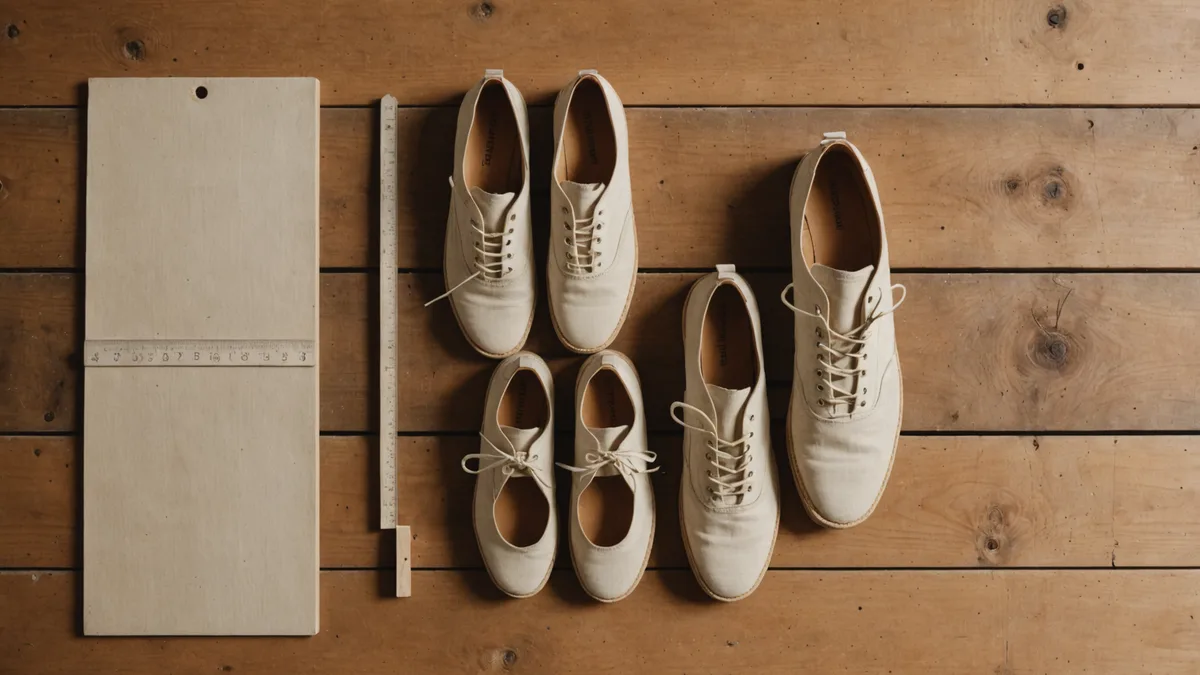
The Arc Runner took eleven prototypes and just over fourteen months from first sketch to final production mold. That pace is slow by the standards of the footwear industry. For us, working out of a small studio in Jingumae with no internal factory and no legacy tooling, it felt about right — maybe even slightly rushed toward the end.
This is the account of how it was made: the decisions, the failures, and one change to the last shape that came so late in the process it made me genuinely anxious. I am writing it because I think the decisions behind a shoe matter as much as the shoe itself. You cannot read a finished product and understand why it exists. The material choices look obvious only in retrospect.
Where it started: a problem I kept running into
In 2019, I started transitioning my own running away from conventional trainers. The story is familiar to anyone who has gone through it: I was dealing with recurring knee discomfort that seemed to worsen over longer distances, and a physiotherapist I trusted suggested I experiment with reducing heel drop and running with a shorter stride. Within three months, the knee issue mostly resolved. Within a year, I had discarded every conventionally structured shoe I owned.
What I could never find — and this was the frustration that eventually became NEULO — was a shoe that took the biomechanical premise seriously while also being honest about what Tokyo running actually looks like. I was not training on trails. I was running on the streets around Yoyogi, on the tile paths through Meiji Jingu, on sidewalks of varying quality in Shibuya and Shinjuku. The ground contact experience in those environments is nothing like grass or compacted dirt. The feedback is harder, more percussive, and completely unpredictable in texture from one block to the next.
The minimalist shoes I was able to source from abroad were designed, I think, with different terrain in mind. They served the biomechanical goal well but left something to be desired in terms of ground-surface dialogue — which is a somewhat precious way of saying they felt slightly dead underfoot on concrete, even though they were thin.
When I founded NEULO in early 2023, the Arc Runner brief was essentially that: a zero-drop, wide-toe-box running shoe with a natural rubber outsole tuned for urban ground surfaces. The question was how to build it.
The first three prototypes: finding the last
I began by working with a craftsman named Takeda-san, whose small workshop is about fifteen minutes from our studio by bicycle. He has been making custom footwear for thirty years, primarily dress shoes and structured sandals. His knowledge of last geometry — the three-dimensional wooden or plastic form around which a shoe is constructed — is precise in a way I have rarely encountered.
Takeda-san was skeptical of the zero-drop brief. Not philosophically; he had no strong opinions about running biomechanics. His concern was structural: a last with no heel elevation changes the load distribution through the entire upper, and without careful management of the toe spring angle and the waist taper, the result looks wrong even when it functions correctly. His exact word, delivered with the polite directness of someone who has heard bad ideas before, was kawaii janai — not cute.
Prototypes 1 through 3 were explorations of last geometry. Each used a simple temporary upper in canvas so we were not wasting material on the parts that were not yet the question. What changed between iterations was the toe box width at the widest point, the curvature of the toe spring, and the medial arch profile. Prototype 3 was the first one that Takeda-san looked at without immediately pointing to something that needed adjustment. We were not satisfied — it still sat oddly when viewed from the lateral side — but we had a working direction.
Material decisions: the outsole argument
While the last development was ongoing, I was working in parallel on materials. The outsole decision was not technically difficult — I had already concluded that natural rubber was the correct choice for ground feedback reasons, and I have written about that reasoning elsewhere. What made it practically complicated was sourcing. The natural rubber supply chain for small-volume footwear production is not well organized. The manufacturers who work with it at scale are supplying major brands under long-term contracts. The remainder of the market is scattered among specialty compounders and traders whose minimum order quantities made no sense for a first production run of a few hundred pairs.
It took four months and a substantial number of conversations before we found a compounder in Osaka who was willing to work with us at a reasonable scale. The compound they could offer had a durometer slightly different from my original specification — harder by about five Shore A points — which meant the grip-versus-feedback balance shifted somewhat from my initial design intent. We tested it across several Tokyo surfaces anyway and concluded the difference was within acceptable range. The grip on wet tile, which had been my primary concern, remained good.
The midsole question was more difficult. Most minimalist shoes use either no midsole at all or a very thin EVA foam layer. We experimented with both. The no-midsole approach produced excellent proprioceptive response but was genuinely uncomfortable on hard urban surfaces for distances beyond about five kilometers for most test runners. The thin EVA option introduced more cushion than I wanted while also deadening the ground texture in a way that felt like it contradicted the whole purpose.
We eventually arrived at a solution that is easier to describe in physical terms than in materials-science language: a very thin layer of natural rubber compound shaped with small geometric channels on the inner face, which compresses differentially depending on where load is applied. It is not a technology story. It is a shaping story. The channels create variation in compliance across the footbed without adding polymer foam to the stack.
Prototypes four through eight: the upper problem
Upper construction occupied the middle phase of development and involved two additional craftspeople: Yamamoto-san, who works primarily in technical fabrics and has collaborated with several outdoor apparel brands, and a smaller atelier in Koenji whose name I am keeping private at their request, who specialize in bonded seam constructions for athletic wear.
The upper brief was minimal: as few seams as possible, no internal structure beyond a light heel counter, breathable without becoming permeable to small debris on urban surfaces. Getting all three of those things to work simultaneously in a low-profile silhouette proved harder than expected. The fewest-seams approach we attempted in prototypes 4 and 5 resulted in an upper that was too elastic in the lateral direction — it would shift under load in a way that disrupted the foot's position relative to the last. Adding lateral structure meant either adding material layers or adding seams.
Prototype 7 was the first version that felt stable in the upper without feeling constrictive. It used a laminated mesh with a light woven backer on the lateral quarter, which added enough structure without perceptible weight increase. We were approximately nine months into development at this point.
The last change that almost undid everything
Prototype 9 was, in my judgment, close to ready. We had the outsole compound, the midsole geometry, a working upper construction, and a last we had been iterating on for the better part of a year. I ran in it for three weeks across my usual routes. It performed well. I was preparing to move toward production tooling.
Then I ran a long session on a particularly rough section of Yamate-dori, a stretch of road that has seen a lot of repair work and is consequently uneven in a concentrated way, and I noticed something in the medial forefoot that I had not previously felt. Not pain — nothing close to pain — but a subtle asymmetry in how the foot was loading at pushoff. Left foot slightly different from right, which was anomalous; my stride is symmetric at pace.
I brought it back to Takeda-san. He put the shoe on the last and looked at it from below for a long time without speaking. Then he pointed to the medial arch profile at the ball of the foot — an area we had not modified since prototype 4 — and said the curvature there was creating a slight valgus tendency in the forefoot when the shoe flexed under load. Subtle enough to not appear in normal running, appearing only when the surface was sufficiently irregular to put the foot into unusual orientations repeatedly.
We were now ten months in. Changing the arch profile at that point meant recutting the last, which meant going back through upper fitting and potentially revisiting outsole geometry. I considered whether the issue was significant enough to justify the delay. I decided it was. Not because anyone else would necessarily notice it, but because I would know it was there.
Prototypes 10 and 11 addressed the medial arch correction. Prototype 11 was the shoe we took to production. The modification was, in the end, about two millimeters of curvature change at a specific location on the last — small in absolute terms, audible in how the shoe sits and moves.
What the process cost and what it taught
Fourteen months of development, eleven physical prototypes, three primary craft collaborators, one outsole sourcing detour, and a last revision that I genuinely did not want to make. The cost in time was significant. The cost in materials and craft fees was the majority of our early operating budget.
I am not romanticizing this. It would have been faster and cheaper to accept prototype 9 and move to production. The difference between prototype 9 and prototype 11 is one that most runners would not consciously identify. I am not claiming that spending more time makes a better product in some absolute sense.
What I do believe is that the decisions accumulated over those fourteen months — each one small, each one made because we were trying to be honest about a specific problem rather than hitting a schedule — produced a shoe whose qualities are coherent in a way that rushed development rarely achieves. Every material choice connects to a function. Every geometry decision has a reason. When someone asks me why the Arc Runner is shaped the way it is, I can trace the answer all the way back to a specific run on a specific street and a specific conversation with a craftsman who has been making shoes longer than I have been running in them.
That is what I wanted to build. Not a feature list, not a technology claim. A shoe with an honest account of itself.