
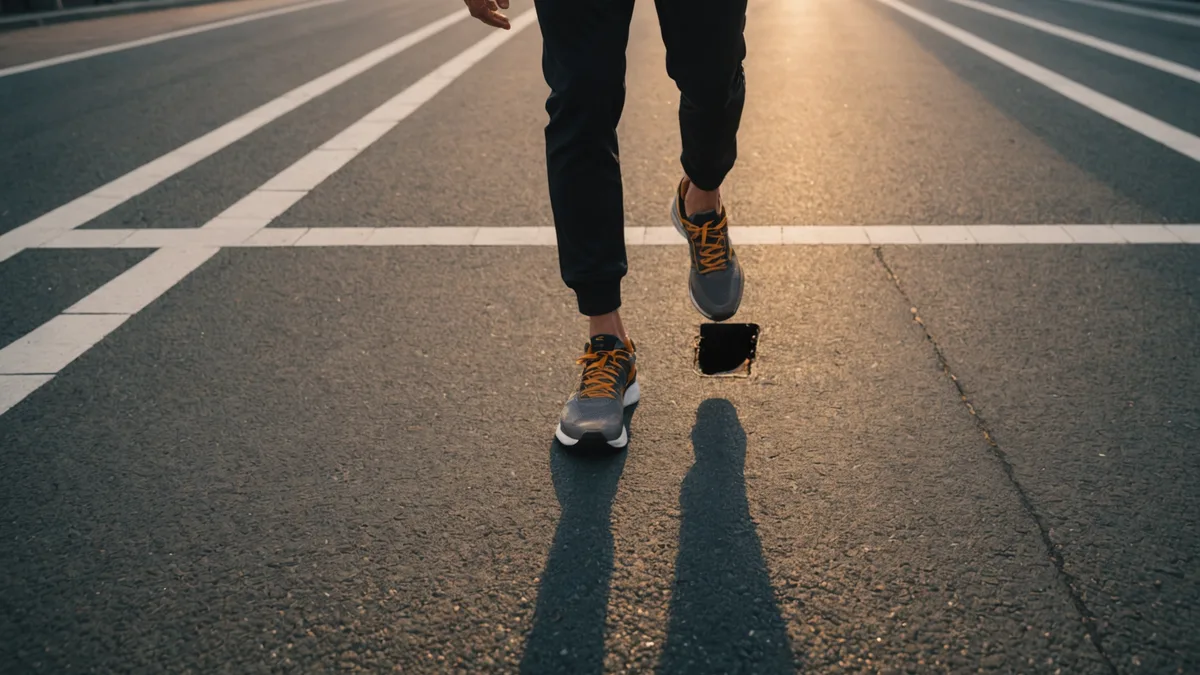
The research literature on barefoot running is almost entirely based on testing done on artificial treadmill surfaces, synthetic track material, or trimmed grass. These are controllable conditions, which is why researchers prefer them. They are also almost nothing like the actual experience of running in an urban environment. A treadmill belt is the same texture at every footfall. A kilometer of Tokyo sidewalk is not.
Part of the early work on what became NEULO's approach to outsole design was done with actual barefoot running in Tokyo — or as close to it as the city makes possible without inviting serious foot injury. I want to describe what those sessions taught me, because the lessons shaped decisions that are now built into the Arc Runner in ways that are not obvious from looking at the finished product.
The surface taxonomy of a Tokyo run
Consider a route I ran frequently during early testing: from the studio in Jingumae, through the back streets of Ura-Harajuku, along the Omotesando approach, into the park at Meiji Jingu, around the inner circuit, and back through the Yoyogi neighborhood. A distance of about seven kilometers. In those seven kilometers, I counted eleven distinct surface categories.
Polished granite at the Omotesando boulevard entrance: cold, smooth, extremely low coefficient of friction when wet. Old concrete sidewalk in the residential blocks north of the park: cracked at regular intervals, with raised edges where frost has lifted sections, and a surface roughness that varies from almost smooth to quite coarse within a single stride's length. The compacted gravel path through the outer park grounds: irregular particle size, some bound into the surface, some loose. The wooden boardwalk near the inner garden: smooth planks with gaps at joints, slightly springy, warm underfoot in a way concrete never is. Standard asphalt on Yoyogi streets: adequate grip, slight give compared to concrete, but embedded with small aggregate that registers clearly through thin soles. And the tactile paving blocks — the yellow ribbed and dotted surfaces installed throughout Tokyo for visually impaired pedestrians — which present a texture of such particular intensity that running over them in anything approaching barefoot condition is an experience that demands full conscious attention.
This is the surface environment that a Tokyo urban runner actually inhabits. None of the testing protocols I had read before starting NEULO had much to say about it.
What the foot does with surface variety
The most important thing I observed during barefoot testing was something that does not appear directly in footstrike mechanics: the way the foot anticipates. When you are running without significant sole protection and you know you are approaching a surface change — the transition from asphalt to tile, say, or from smooth to textured — the foot modulates its landing well before contact. The toes spread slightly more. The contact becomes slightly more tentative, the stride length shortens, and the foot lands in a more parallel orientation to provide a larger contact area and reduce peak pressure on any single point.
This anticipatory behavior is driven by visual input — you see the surface change coming — but it is also driven by the proprioceptive memory of previous contact with that surface type. A foot that has run over polished granite before knows to expect low friction and adjusts accordingly. This is not a conscious decision. It happens faster than deliberate thought and feels, in the moment, simply like the body knowing what to do.
In conventional running shoes with substantial cushioning, this anticipatory system is largely bypassed. The shoe provides a standardized interface with every surface, which means the foot never needs to develop a nuanced model of the surfaces it traverses. The information is there, attenuated and delayed by the foam and rubber stack, but not in a form that the nervous system uses effectively.
In genuinely thin soles — the 3–4mm range that approaches barefoot — the surface information passes through with enough fidelity that the anticipatory system functions. You feel the transition coming through your soles before your eyes confirm it. The body responds. The run feels more alive, and also more honest.
What concrete teaches that grass does not
There is a reason most barefoot running advocates recommend starting on grass: it is forgiving. The surface gives under load, the texture is consistent, and the coefficient of friction is broadly favorable. It is an excellent environment for learning the basics of forefoot contact without accumulating impact stress too quickly.
What grass does not teach is the precision required for harder surfaces. Concrete has no give. The impact transient — the sharp initial force peak at foot contact — is absorbed entirely by the foot and leg rather than by any compliance in the surface. On grass, the body's natural impact-absorption system — the way the calf muscles eccentrically load at contact, the way the arch spring stores and returns energy — has some forgiveness built in by the surface itself. On concrete, the system has to work correctly or the foot knows immediately.
This is uncomfortable to learn, but the discomfort is informative. Running barefoot on concrete in Tokyo teaches you where in your foot the energy is not being managed well. A heavy contact at the heel registers as a sharp reminder to shorten the stride. A rigid forefoot that is not articulating through the metatarsals produces a percussion at the ball of the foot that feels wrong enough to prompt correction. The concrete is an honest teacher precisely because it offers no padding of its own.
For outsole design, this meant that the surface we most needed to tune for was not the gravel path or the soft track. It was the flat, slightly rough, unforgiving asphalt and concrete that constitutes most of any urban running route. Everything else is variation within a range that a well-tuned concrete-appropriate outsole handles adequately. Getting concrete right gets most surfaces right.
The wet tile problem
One surface condition deserves separate discussion: wet smooth tile. This is, in practical terms, the most dangerous surface condition a Tokyo runner encounters regularly. The station plazas, the Omotesando boulevard entrance, the covered arcades — all of these have polished stone or tile surfaces that approach zero friction when wet. A conventional running shoe's grip system, designed primarily for asphalt, fails badly on wet tile. The tread pattern that provides friction on rough surfaces does nothing on a surface smooth enough that there is nothing to interlock with.
Barefoot contact on wet tile is, counterintuitively, more stable than shoe contact. The foot's skin deforms to the surface at a molecular level, creating a suction-like adhesion that increases with pressure. This is not a property that transfers well to most rubber compounds — the smooth bottom of a racing shoe, for example, can slide on wet tile as badly as a smooth sole of any material. What we found during testing was that the natural rubber compound we were considering, at the durometer we sourced, had significantly better wet-tile adhesion than either carbon rubber or SBR alternatives at similar hardness levels. This is attributable to the molecular structure of natural rubber, which has higher surface energy under these conditions.
Wet tile did not drive our outsole material selection — the ground-feedback properties did. But it confirmed that the choice was correct for the specific urban context we were designing for.
The city as design specification
I run in other cities occasionally — on visits, for a session or two — and the experience is always illuminating by comparison. Singapore's wet tropical surfaces, Seoul's polished commercial districts, the particular concrete texture of certain European cities. Each urban environment has its own surface vocabulary, its own set of demands on footwear.
Tokyo's demands are, in my experience, among the highest in terms of surface variety and challenge. The city's sidewalks combine very old and very new paving, accommodate extreme weather variation across seasons, and include the tactile guidance system that no other city deploys at quite the same density. Running here in a shoe that takes ground contact seriously is a specific experience that no laboratory testing environment can replicate.
The Arc Runner was designed in Tokyo, tested in Tokyo, and tuned for the specific demands that testing revealed. That does not mean it is only a Tokyo shoe — the same surface challenges appear in every dense urban environment. But the specificity of where we tested is not incidental. The city is in the shoe, if you know where to look for it.