
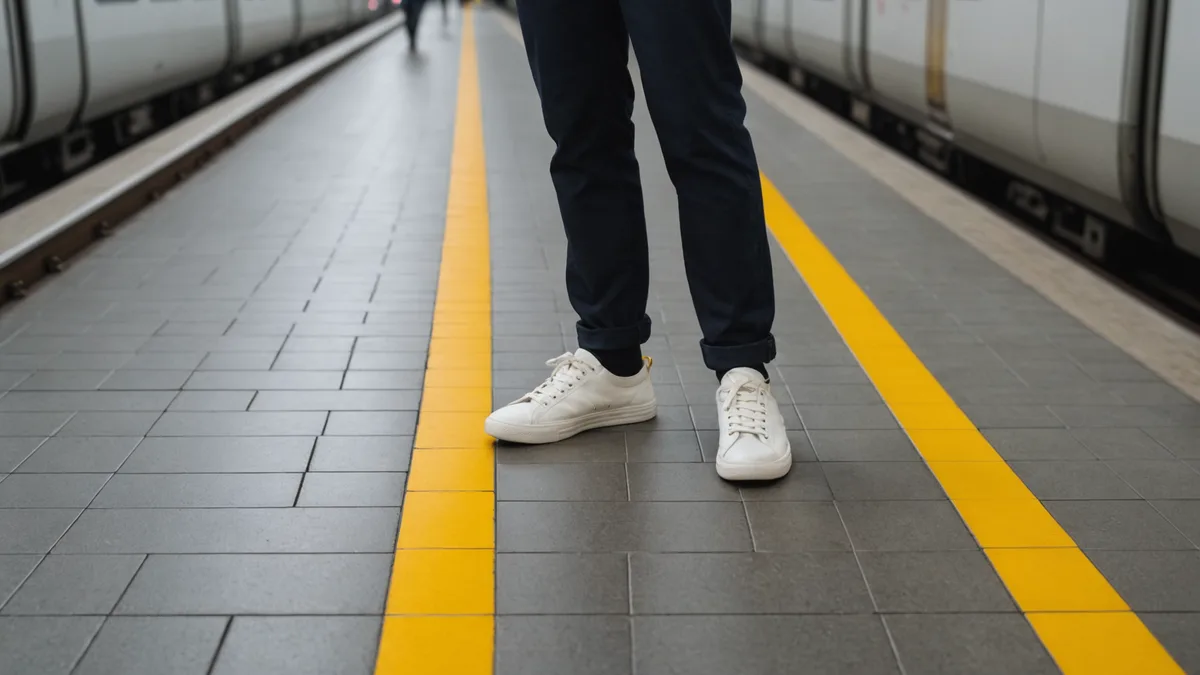
The Urban Flat was designed specifically for Tokyo commuting — that combination of walking distances, train standing, concrete and tile platforms, stairs, and the occasional unexpected sprint for a closing door. But designing for a context and wearing something in that context every day for six months are different things. The latter shows you what you missed.
I wore the Urban Flat as my primary daily shoe from early autumn through late winter — the kind of period that in Tokyo includes summer-to-autumn warmth, the damp cool of November, cold December pavement, and the particular harshness of late February concrete when it's been cold long enough that the ground itself seems harder. Six months, five days a week, typically seven to ten kilometers of walking per day between my studio in Jingumae and wherever the day took me.
This is what I learned.
The first three weeks: what the city tells your feet
If you've come from conventional cushioned footwear, the first experience of serious daily walking in a zero-drop minimal shoe will be noticeable. Not necessarily painful — and the Urban Flat's construction is softer than the Arc Runner's, with a slightly thicker natural rubber sole profile designed for cumulative daily loading rather than biomechanical intensity — but the difference is present.
Tokyo's pedestrian infrastructure is varied in ways that become interesting when your foot is closer to it. JR station platforms use a hard-poured concrete with a characteristic surface texture, slightly rough, consistent. Shibuya's elevated pedestrian bridges use a different aggregate, slightly more granular. The underground sections of Omotesando station are polished concrete, smooth enough to be slightly slippery in wet weather. Jingumae's side streets have sections of interlocked concrete tile, sections of asphalt patched over older brick, occasional poured concrete with joint lines that you feel underfoot when you cross them.
None of this is painful. Most of it becomes background awareness rather than foreground sensation within a week or two. But it's there, and it was information I wasn't previously receiving through the layered midsole of a conventional shoe. There's a version of this that's pleasant — being more present in the environment you're moving through. There's also a version where it's simply more input. Both are true simultaneously.
Standing on platform surfaces for thirty minutes at a time
This was the biggest practical discovery. Running in minimal shoes and commuting in them are different biomechanical situations. Running involves constant movement and load distribution across each stride cycle. Standing still on a hard surface for twenty to thirty minutes, as happens waiting for delayed trains or standing in crowded carriages, is a different kind of demand — sustained static loading on the heel and metatarsal heads without the elastic energy cycling that running provides.
In the first month, sustained platform standing produced more foot fatigue in the Urban Flat than I expected, specifically in the arch and the metatarsal region. This is not a flaw in the shoe. It's the foot being asked to maintain postural position under static load without the dampening that a conventional insole provides — and it's exactly the kind of load that intrinsic foot muscle training addresses.
By month two, the fatigue had substantially reduced. The intrinsic muscles had adapted to the static loading demand in a way they hadn't when I was running daily but standing in cushioned shoes. There's a distinction between running fitness and standing fitness that minimal footwear makes concrete.
I want to be honest about the timeline: if you are transitioning to minimal daily wear and you stand for long periods as part of your commute, expect four to six weeks before the standing becomes comfortable. It will. But it's not instantaneous.
Wet weather, tile, and the traction question
Tokyo's wet season covers June and July, with additional rain events in September and October. The tile surfaces at many stations — particularly the shiny polished stone of some newer development areas — become genuinely slippery when wet. The Urban Flat's natural rubber outsole performs well on wet concrete and standard station platform surfaces. On polished stone tiles, it's adequate but not confidence-inspiring.
Conventional athletic shoes with aggressive synthetic rubber compounds in the outsole, often with carved drainage channels, grip polished wet tile better. This is a real trade-off. Natural rubber's friction properties on wet polished surfaces are not as strong as some synthetic compounds, and the Urban Flat's flat profile means there's no drainage architecture in the sole.
In six months of daily wear through wet seasons, I had one genuinely close-call slip on the wet entrance tiles of a department store in Minami-Aoyama. The surface was essentially a mirror with a thin water film. That particular surface would challenge most footwear. But it's worth naming the limitation rather than pretending it doesn't exist.
What the shoes looked like at six months
The most visually striking change was the flexion creasing of the upper at the metatarsophalangeal joint line — the point where the foot bends with each step. At five to six months of daily wear, this crease is permanent and visible. The canvas has softened noticeably along this line, which is exactly what happens to material that bends approximately ten thousand times per day.
This is worth addressing directly because some people will experience this as the shoe looking worn and feel uncertain about it. The crease is structural memory, not damage. The canvas in that region has become more pliable, which is correct behavior for a zero-drop shoe where the forefoot flexibility is the point. The structural integrity of the lasting margin and outsole bond remained sound through the six months.
The outsole showed thinning at the ball of the foot and the outer heel — the predictable wear pattern for someone whose gait has a slight supination tendency. This is honest wear. A conventional shoe's cushioned midsole often disguises this pattern until the outsole rubber wears through suddenly. The Urban Flat's single-layer rubber sole shows the pattern gradually, which is the information you'd want to have about your gait.
The unexpected discovery: transitions and posture
The observation that surprised me most in six months of daily wear was posture-related. By month three, I noticed that my standing posture in the Urban Flat was different from my posture in the runners. In both cases I was in zero-drop shoes, but the Urban Flat's slightly more relaxed sole flex and lower-cut upper seemed to encourage a softer, more settled standing posture — weight distributed more evenly across the whole foot rather than concentrated at the ball.
I don't have an instrumented explanation for this. It may have been the accumulated months of adaptation, the shoe's specific geometry, or simply the difference between movement contexts. But the subjective experience was of the foot feeling more planted and more relaxed in extended standing and slow walking in the Urban Flat than in any other shoe I'd worn for that purpose.
Whether this generalizes, I can't say. Six months is long enough to observe but not long enough to be certain about cause. What I can say is that by month six, the Urban Flat had become the shoe I reached for without thinking — not because it was the most comfortable option in the conventional sense, but because it felt most like not wearing a shoe at all. That's what we were building toward.
Who should consider this, and what to expect
The Urban Flat as a daily commuting shoe works well for people who are already partially adapted to minimal footwear — who have done some foot strength work, who run occasionally in lower-drop shoes, or who have simply been wearing flatter shoes for a year or more and notice the transition less acutely. For someone coming directly from maximally cushioned footwear and making this their everyday shoe immediately, six months will have more difficult stretches than mine did.
We're not saying the Urban Flat requires athletic preparation to wear. But transitioning more gradually — using it a few days a week at first, increasing as foot strength builds — will make the six-month experience more consistent than going full-time immediately. The foot adapts. The question is only how much time you give it.