
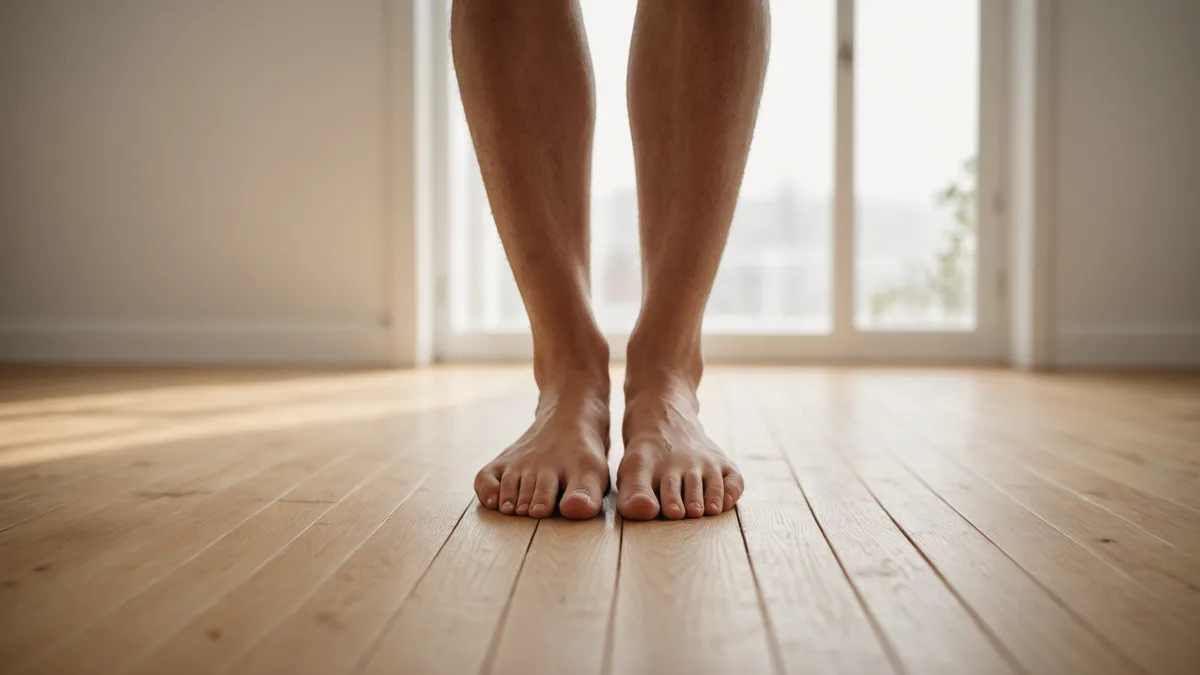
The human foot contains 26 bones, 33 joints, and more than 100 muscles, tendons, and ligaments. It is, by almost any structural measure, among the most mechanically sophisticated structures in the body. And most runners treat it as passive infrastructure — something that carries them forward while everything from knee to hip does the actual work.
The consequence of this neglect shows up predictably when people transition to zero-drop footwear. The Achilles tendon, calf complex, plantar fascia, and the intrinsic foot muscles — the small muscles contained within the foot itself, as opposed to the extrinsic muscles originating in the lower leg — are suddenly called upon to do things they have been underloaded for years. The result, for people who move too fast, is injury. Usually calf tightness, sometimes plantar inflammation, occasionally Achilles tendinopathy.
We're not saying that zero-drop footwear causes injury. The evidence is more nuanced than that. What we are saying is that the transition, done without preparation, loads structures that may not be ready. The shoes are not doing anything wrong. The feet simply need time and deliberate work to be equal to what the shoes ask of them.
Understanding what changes at zero-drop
In a conventional running shoe with a heel-to-toe drop of 8 to 12mm, the elevated heel positions the ankle in slight plantar flexion before ground contact. The calf and Achilles tendon work across a shortened range of motion. Over years of running in this geometry, the posterior chain adapts accordingly: the Achilles can become less extensible, the calf complex less responsive at full dorsiflexion, the intrinsic foot muscles progressively less engaged because the rigid midsole does much of the load distribution work.
At zero-drop, the ankle works through its full range. The Achilles tendon operates across a longer arc. The foot's longitudinal arch must manage elastic energy storage and return — the spring mechanism that research in barefoot biomechanics has documented extensively. The intrinsic foot muscles, particularly the flexor digitorum brevis and the abductor hallucis, become primary rather than supplementary stabilizers.
This is not a deficit of the shoe. It is actually the shoe asking the foot to work as it was structured to. But asking an under-prepared structure to work fully and immediately is how overuse injuries happen.
The exercises, in order of priority
The following sequence is what I worked through before transitioning my own running in 2019, and what I've refined in the years since. There's no mystery to it. None of these movements require equipment. They require patience and daily attention, for approximately four to eight weeks before you start running meaningful distances in minimal footwear.
Toe spread and individual toe extension
Sit or stand barefoot on a flat surface. Spread all five toes as wide as possible without assistance, hold for five seconds, release. Then attempt to lift each toe individually while keeping the others in contact with the floor. This sounds simple. For most people who have worn conventional footwear for years, it is genuinely difficult. The neural pathways that allow independent toe control are present but often undertrained.
This matters for running because a functioning toe splay at push-off contributes to stable propulsion and reduces medial loading at the first metatarsophalangeal joint. Do three sets of ten per foot, daily.
Short foot exercise
This exercise trains the intrinsic foot muscles responsible for maintaining the longitudinal arch. Stand barefoot, feet hip-width apart. Without curling your toes, shorten the foot from front to back by drawing the ball of the foot toward the heel — not by gripping, but by tensioning the arch itself. Hold for five to eight seconds, release fully. Repeat ten times.
When you first attempt this, you will likely feel the movement happening in your toes rather than your arch. With practice, the engagement moves up into the intrinsic musculature. This is the transition you are training toward. The short foot exercise has appeared in rehabilitation literature for plantar fasciitis for good reason — it directly addresses intrinsic weakness, which is a significant contributor to arch dysfunction under load.
Single-leg calf raises, full range
Stand on one foot on a flat surface. Rise fully onto the ball of the foot, hold briefly at the top, then lower slowly through heel down and then further into a dropped position if you're standing on a step edge. The lowering phase — the eccentric component — is where Achilles tendon conditioning happens.
Do not use the step at first. Start with flat surface, single leg, controlled descent. Three sets of fifteen, working toward slow tempos (three to four seconds down). Only add range by standing at a step edge after two weeks of flat surface work, when the tendon has begun adapting.
I would argue this is the single most important preparatory exercise for the transition to zero-drop running. Achilles tendinopathy in early minimal footwear users is almost always traceable to insufficient eccentric loading preparation.
Barefoot balance and proprioceptive loading
Stand on one foot, barefoot, on a firm but non-flat surface — a folded towel, a yoga mat, a slightly uneven surface. Hold for thirty seconds. Progress to thirty seconds with eyes closed. Progress further to small perturbations (tapping the standing foot's heel lightly while balancing).
This isn't coordination training in isolation. Barefoot balance work activates the mechanoreceptors in the plantar fascia and the metatarsal heads — the sensors that regulate postural adjustments in real time. When these pathways are active and responsive, the transition to minimal footwear feels intuitive rather than clumsy. When they're undertrained, people often describe their first runs in minimal shoes as unstable, as if the foot doesn't know what to do with the information it's receiving.
Walking barefoot — the often-skipped foundation
Before any running in minimal footwear, walk in them. A lot. Thirty minutes of daily walking in zero-drop shoes or barefoot, for two to three weeks, accomplishes two things: it builds loading tolerance gradually in the Achilles and plantar fascia, and it trains the gait adjustments — shorter stride, softer contact, more forward lean — that prevent the overloading patterns common in transitioning runners.
The temptation to skip this step is strong, especially for experienced runners who feel the walking is too easy to be training. It is not training in the conventional sense. It is accumulation of tissue adaptation that takes time regardless of fitness level. The cardiovascular system adapts faster than connective tissue. Your lungs will be ready before your feet are.
Timeline and realistic expectations
Four weeks of the above, combined with walking, is sufficient preparation for most people to begin easy running in zero-drop footwear — with a significant caveat: begin at 20 to 30 percent of your normal running volume, and increase by no more than 10 percent per week. The usual ten-percent rule for running load applies, but the baseline here is lower than you might assume.
Soreness in the arch, calf, and the intrinsic foot muscles is normal in the first two to three weeks of running. Sharp pain in the heel or Achilles insertion is not. If the latter appears, step back to walking and return to the calf raise progression.
The most common mistake I see from people who contact us after an injury while transitioning: they ran at full previous volume in the first week. The preparation exercises were done, the walking was done, and then they ran twelve kilometers on day one because they felt ready. The tissue adaptation lagged three to four weeks behind what felt like readiness. The preparation is not wasted in that scenario — but it can't compress the connective tissue adaptation timeline.
What you're building toward
The goal of this preparation isn't just injury avoidance. It's building a foot that can participate in running rather than one that merely tolerates it. When the intrinsic muscles are trained, the arch functions as a spring rather than a passive structure. When the Achilles tendon has been conditioned through full-range eccentric loading, it can store and return elastic energy across the stride cycle. When the mechanoreceptors in the plantar fascia are regularly engaged, the nervous system receives better ground information and makes better adjustments in real time.
These are not marginal gains. They are what running in minimal footwear actually feels like when the foundation is in place — the reason people who make the transition carefully rarely go back to elevated heels. The shoes don't create this. The preparation and time does. The shoes simply stop getting in the way.