
Our studio is at 3-14-5 Jingumae. From the front door, Takeshita-dori is about a four-minute walk north. The Cat Street entrance is closer — maybe two minutes south. We did not choose the location because of what those streets represent; we chose it because the rent was acceptable and the light through the east-facing windows is good in the morning. But you cannot spend most of your working days in Harajuku without the neighborhood doing something to how you think about objects.
I want to write about what that has meant for NEULO — specifically, what the street-level footwear culture in and around Jingumae has taught me about the difference between a shoe that is technically correct and a shoe that someone actually cares about.
A neighborhood that reads shoes carefully
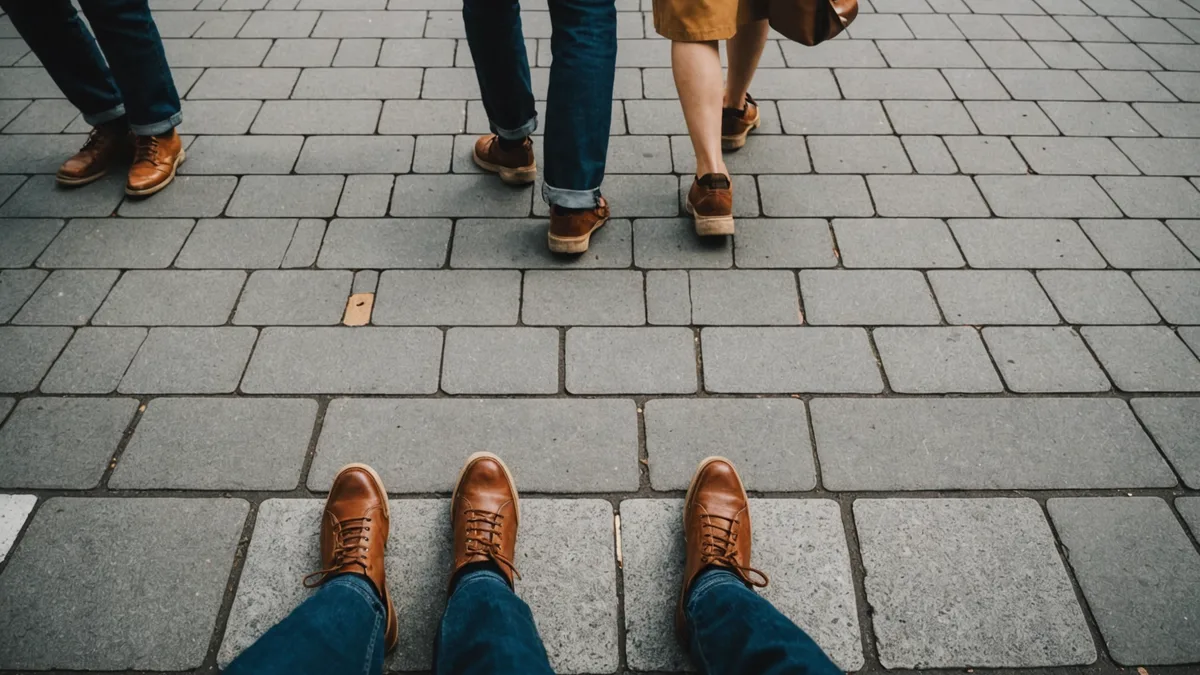
In most urban environments, the people you pass on the street are not thinking about your shoes. In Harajuku, they are. Not aggressively — not in the way that reads as judgment — but attentively. The visual grammar here is finely developed. A person who has spent time in this neighborhood develops a peripheral awareness of footwear that is not really about brand recognition. It is more like an awareness of choices: what material is that, why does the silhouette sit that way, is the proportion deliberate or accidental.
I first noticed this acutely when I was wearing an early prototype of what became the Arc Runner — a version that performed well in testing but that I had not yet resolved visually. I was getting a coffee from a place on Ura-Harajuku I use most mornings, and a young man at the next table looked at the shoes, then looked away, in a way that communicated something specific. Not disapproval. More like: those are a work in progress and you both know it.
That feeling — the slight discomfort of being seen clearly by someone who understands the material language you are working in — clarified something for me. A shoe that is biomechanically correct but aesthetically unresolved is not a finished product. It is a prototype that got packaged. And in a neighborhood where footwear is read the way typography is read by designers — quickly, subconsciously, with high discrimination — an unresolved shoe is more conspicuous than an absent one.
What Harajuku style is actually about
There is a common misreading of Harajuku style as maximalism — a particular foreign-press narrative about eccentricity and color and costume. That narrative is based on a real thing that existed in concentrated form on Takeshita-dori in a particular period, and it still surfaces in certain corners of the neighborhood. But the more persistent aesthetic that I observe day to day in Jingumae is something closer to the opposite: extreme care about small things, deliberate restraint in material and silhouette, a preference for objects that justify themselves through quality of detail rather than scale of statement.
The ura-Harajuku sensibility — the back streets between Omotesando and the park — is particular about craft. You see vintage Japanese workwear worn with attention to how it ages. You see footwear in materials that most people could not identify by brand but that are clearly not accidental: waxed canvas, vegetable-tanned leather at a certain stage of patina, natural rubber soles worn to a specific stage of smooth. The objects say: I was chosen for specific reasons, and I have been used.
That is an aesthetic position, but it is also an ethics of making. The shoes that command sustained attention in this neighborhood are not the ones with the largest visual presence. They are the ones whose visual weight comes from decisions that make sense when examined closely.
The problem with "functional minimalism" as an aesthetic
I am not claiming that NEULO is a Harajuku brand in any direct stylistic sense. We are a performance footwear company that happens to be based in Jingumae. The shoes we make need to function well across kilometers of urban running; they are not primarily objects of street style.
What I am saying is that proximity to this neighborhood made us more critical of a particular failure mode in the minimalist footwear category: the design that is minimal in the sense of having stripped everything away, but has not done the work of making the resulting form feel intentional. There is a wide toe box on many minimalist shoes that reads as a medical accommodation rather than a designed shape — technically correct but visually uneasy, as if the designer was apologizing for the biomechanics while implementing them. We are not interested in that version of minimalism.
The form of a shoe that respects natural foot anatomy does not have to look compensatory. It can look like a foot: which is to say, something with its own proportional logic, not a standard last with an apology attached to the front. Getting there required us to think about the toe box as a shape to be designed, not a width to be increased. That distinction — small in description, large in outcome — came directly from spending time in an environment that is fluent in the difference between a resolved form and an adjusted one.
Craft attention as a shared language
One practical effect of working in Harajuku has been access to a dense network of people who are genuinely interested in how things are made. This is not unique to this neighborhood, but it is concentrated here. Within a ten-minute walk of our studio there are shoemakers, textile importers, leather workers, a specialist in Japanese rubber compounding whose family has been in the business for three generations, and several small studios whose makers have deep knowledge of specific material processes.
These relationships have been practically useful — the natural rubber compounding contact was a direct result of a conversation at a neighborhood event, not a trade show introduction. But more than the practical network, what the community offers is a kind of ongoing quality calibration. When you are surrounded by people who notice material decisions the way other people notice spelling errors, your standard for what constitutes a finished product rises.
I brought a late prototype of the Arc Runner to a small gathering of makers from the neighborhood earlier this year — not to solicit feedback formally, but simply because it is natural in this context to show what you are working on. The conversation that followed was not about performance or biomechanics. It was about the geometry of the toe spring, the way the outsole compound had been colored, the decision to leave the midsole edge uncoated. These were the details that the room read. They were also the details I had spent the most time on, which confirmed something: the effort had gone to the right places.
What we are not saying
I want to be clear about the limits of this influence. We are not making fashion footwear. We are not dressing the Arc Runner in the visual vocabulary of Harajuku streetwear and calling it contextual authenticity. That would be a kind of appropriation — taking the cultural surface without the underlying rigor.
What I am describing is more like a standard of attention: the neighborhood enforces a level of care about objects that has made us more serious about our own object-making. The biomechanical brief — zero drop, wide toe box, natural rubber, proprioceptive honesty — came from science and personal experience with running. The aesthetic brief — that the shoe should look like it means to be exactly what it is, nothing added, nothing apologized for — came at least partly from spending time in a place where that quality is noticed and where its absence is also noticed.
A shoe that people care about is not achieved by making people feel they should care about it. It is achieved by making it worthy of the attention it will receive from the people who already know how to look. In Harajuku, those people are everywhere, and they are looking.