
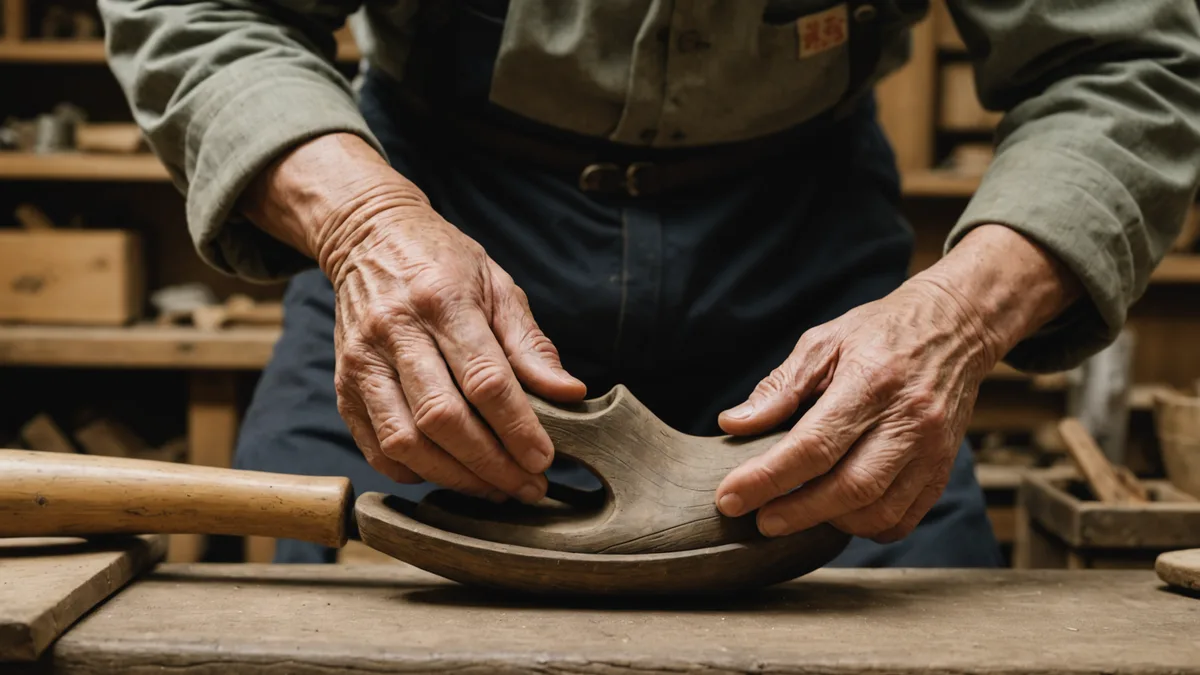
Asakusa, in the northeastern part of Tokyo, has been making shoes by hand since the Meiji era. The neighborhood's shoemaking district — concentrated around the streets behind Kaminarimon — grew into Japan's primary footwear manufacturing center through the twentieth century, supplying department stores, military contracts, and eventually some of the country's more distinctive domestic brands. Many of the workshop families there have been working in leather and canvas for three or four generations.
When I started developing the first NEULO prototype in 2023, I went to Asakusa to learn rather than to place an order. I wasn't ready to place an order. I didn't know what a last should look like, how to specify a sole bond, what questions to ask about stitch density or toe allowance. I went to listen, and I came back several more times before I understood enough to begin a real conversation about production.
What I learned there changed how I think about shoe construction — not only in the practical sense of knowing what to specify, but in the deeper sense of understanding what "quality" actually means in footwear, and why the people who have been doing this for decades are suspicious of shortcuts in ways that aren't always legible to someone approaching the craft for the first time.
The last as foundation
The last is the three-dimensional form — traditionally carved in wood, now often plastic — around which a shoe is shaped. Its geometry determines everything: the toe box volume, the arch profile, the heel seat, the relationship between ball girth and instep height. A good last, in the view of the Asakusa craftspeople I spent time with, is not a template but a theory of the foot. Every dimension is a claim about how a specific type of foot moves and where it needs room.
The most important lesson from the workshop was this: the last comes before the material, not after. In fast-fashion footwear development, the process often runs in reverse — a visual is designed, materials are selected to fit the visual, and the last is adapted to accommodate both. The Asakusa approach is to begin with the foot geometry, work outward to the last, then determine what materials can serve that geometry honestly. Aesthetic follows function, but it also follows material truth — an unbleached canvas upper behaves differently than treated leather, and the last shape should reflect that.
This sequencing is one of the things that most influenced how we develop NEULO shoes. The Arc Runner's wide toe box geometry was determined before we settled on the canvas upper. We knew what the foot needs in the metatarsal region at push-off — room for natural toe splay, no lateral compression — and built outward from that. The canvas was chosen for properties that were consistent with that geometry, not adapted around it.
What durability means in Asakusa
The craftspeople I worked with measured quality by a different standard than I initially expected. It was not primarily about how long the shoe would survive, though longevity was part of it. It was about whether the shoe would fail gracefully or catastrophically — and specifically, whether the failure would be visible to the wearer before it became structural.
In workshop terms: a shoe should show wear before it loses integrity. The canvas should begin to soften and show flexion lines before the sole bond weakens. The outsole should thin at the ball and heel before it delaminates. These signals tell the wearer that the shoe is aging and guide decisions about resoling or replacement. A shoe that looks pristine until it suddenly falls apart — common in synthetic-heavy construction — is regarded in Asakusa as a quality failure, not a quality success.
This concept influenced our material choices directly. Natural rubber ages predictably — it wears through at contact points rather than suddenly separating from the upper. Unbleached canvas softens with flexion rather than cracking. The materials announce their aging, which is something we've come to think of as an honesty in the shoe rather than a limitation.
Stitch density and the unseen structure
One of the older craftsmen I spent time with had a particular focus on the lasting margin — the strip of upper material folded under the insole and stitched or cemented to the outsole. He would pull the lasting edge of a finished shoe and judge it not by whether it came loose, but by the quality of the resistance — the evenness of tension across the margin, the absence of gathering or stress concentrations. He was reading the shoe's internal structure through its surface behavior.
This is the kind of knowledge that doesn't transfer in written specification. It transfers through observation, over time, in a workshop where someone with that knowledge is willing to demonstrate it. We were fortunate to have that opportunity. The resulting construction standards for NEULO's lasting margin are influenced by what I learned in those sessions — a specific stitch density, a minimum margin width, and an insistence on manual tension check at each lasting point rather than relying solely on the uniformity of machine work.
I want to be clear: we're not saying that machine work is inferior or that craftsmanship requires rejection of production tools. The workshops in Asakusa use industrial sewing machines. The distinction is in the quality control step, which in a well-run workshop is done by a person who knows what they're looking for, not replaced by an assumption that the machine did it correctly.
Material patience
There's a term that came up repeatedly in Asakusa, not as a formal concept but as an attitude: the willingness to wait for a material to settle before making a final judgment. Canvas fresh from the bolt is not the same as canvas that has been stretched over a last, conditioned with humidity, and allowed to set. Natural rubber bonded to canvas in a hurry behaves differently at the flex point than rubber allowed to cure fully before stress testing.
This material patience — the recognition that physical processes have timelines that production schedules sometimes try to compress — is something we've tried to carry into our development process. The Arc Runner prototype took three failed iterations before we had a sole bond we were satisfied with. In retrospect, two of those failures were partly about rushing the cure stage. We weren't patient enough with the material. The workshops are. They've learned, across generations, what happens when you try to skip the steps that require time.
What we took from Asakusa into NEULO's construction
Concrete things: our last development sequence puts foot geometry first. Our lasting margin spec comes from manual check standards rather than pure machine confidence. We use a natural rubber sole compound that shows wear predictably — not a compound chosen for visual uniformity. We allow cure time in our production cycle that a faster manufacturer would cut.
Less concrete but equally present: an attitude toward material honesty that treats the shoe's aging as part of its character rather than something to be disguised. A resistance to construction shortcuts that produce clean-looking results with unknown long-term behavior. A preference for the question "will this fail visibly?" over "will this look good in the first month?"
We're a small operation. The Asakusa craftspeople we've worked with are working at a scale and with a depth of accumulated knowledge we won't approach for a long time, if ever. But the direction they showed us — the sequencing of decisions, the standards for material behavior, the philosophy of durable construction — is something we can follow at whatever scale we operate. It's not a tradition we're appropriating. It's one we were invited into cautiously, and that we're trying to honor by building honestly.