
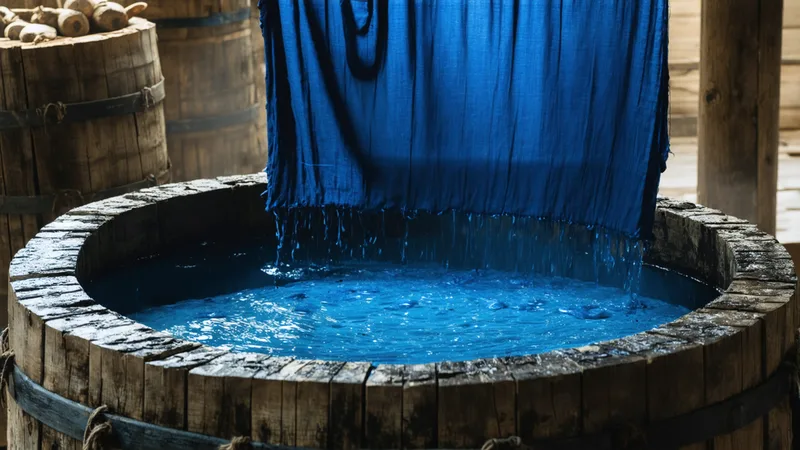
Limited Run 003 has been in development for over a year, longer than either of its predecessors. The hold-up was not the last shape or the sole construction — those were resolved early. What took time was the colour. Specifically, the process of arriving at a colour that we felt was honest about what it was: not a dye applied to a surface, but a transformation that lives inside the fibre itself. That led us to Tokushima, and to a way of working with indigo that most of the world has forgotten how to do.
Why Tokushima
Tokushima prefecture on Shikoku island has been the centre of Japanese indigo cultivation and dyeing for several centuries. The specific variety of indigo plant grown there — tade-ai — produces a pigment with a depth and complexity that is distinct from synthetic indigo and from indigo grown in other regions. The prefecture's humid climate and particular soil composition contribute to a leaf chemistry that experienced dyers consistently describe as richer and more complex than alternatives. We spent time there understanding this before we committed to using it.
The craftsperson we work with, based in a small workshop outside Tokushima city, has been working with sukumo — the composted, fermented leaf preparation that is the basis of traditional Japanese indigo dyeing — for most of their adult life. When we first visited, we brought samples of the unbleached canvas we use in our standard uppers and asked whether this fabric could absorb sukumo dye to the depth we were imagining. The answer, after some initial testing, was yes — but it would require multiple dye baths over several days, and the result would vary in ways that no synthetic process could replicate. We thought about that for a while. Then we decided that variation was the point.
What sukumo actually is
Conventional indigo dyeing — including most of what is sold as "natural indigo" in contemporary fashion — uses indigo pigment extracted from leaves and dissolved in an alkaline reducing solution. Sukumo is different. It is the dried and composted leaf of the tade-ai plant, fermented over many weeks in a process that the dyer must manage daily by monitoring temperature, pH, and the smell and texture of the vat. The fermentation converts the insoluble indigo in the leaves into a soluble, reduced form that can penetrate textile fibre. When the fabric is removed from the vat and exposed to air, oxidation converts the pigment back to its insoluble form — now locked inside the fibre structure rather than sitting on its surface.
This is why sukumo-dyed fabric fades differently from surface-dyed fabric. The pigment is not being worn away from the outside in — it is changing through oxidation and use in a way that reveals the undyed fibre in some areas while the indigo remains deep in others. The result, over months and years of wear, is a patina that records how the shoe has been used: where it flexes, where it contacts the ground, where the upper creases under foot movement. We find this quality genuinely interesting. A shoe upper that changes according to use is telling you something about the relationship between the object and the body wearing it.
The dyeing process for Limited Run 003
The canvas upper pieces for Limited Run 003 are dyed before construction, not after. This matters because it means the cut edges, the stitching channels, and the internal layers of the shoe all carry the same dye — the colour is consistent through the material rather than only on the outer face. When the upper is constructed and the shoe is lasted, the indigo is already integral to the fabric in the way it would be in traditional Japanese textile work.
Each upper requires five to seven individual immersions in the sukumo vat, with air-oxidation time between each bath. The total process takes approximately two to three days per batch of upper panels. The depth of colour achieved depends on vat conditions, which vary with season and temperature — which means that Run 003 shoes produced in early production will be slightly different from those produced later, and shoes from the same batch will vary from one another in ways that are imperceptible but real.
We considered whether to try to control for this variation more tightly. We decided against it. The variation is not a quality defect. It is a record of the conditions present when the dye bath was active — a kind of timestamp that makes each pair slightly singular. This aligns with the reasoning behind the Limited Run series generally, which exists to explore what a shoe can mean when it is not optimised for consistency at scale.
What indigo does to the canvas
Beyond colour, the sukumo dyeing process slightly changes the hand and weight of the canvas. The fermented indigo compounds interact with the cotton fibre in ways that appear to increase abrasion resistance over time — a property that traditional Japanese craftspeople have noted for centuries and that is now the subject of more formal material study. The canvas feels fractionally stiffer when new, and softens through use in a characteristically pleasant way as the fibre structure relaxes.
We chose our standard unbleached canvas for this upper specifically because its natural off-white base interacts with the sukumo pigment differently than bleached cotton would. The residual plant matter in unbleached cotton appears to provide additional surface area for pigment bonding. The result is a colour that sits more deeply in the fabric and exhibits the characteristic depth variation — lighter where the weave is raised, darker where the fibre is compressed — that distinguishes hand-dyed from machine-dyed material.
Availability and what comes next
Limited Run 003 is available in a single colourway — the deep indigo described here — in an Arc Runner base configuration. The run is limited to 120 pairs. We do not plan a second production run in this colourway, though we may revisit Tokushima indigo dyeing in future Limited Runs using different base materials or different dyeing schedules to produce different colour outcomes.
The craftsperson in Tokushima has already suggested a few directions worth exploring: a lighter wash achieved by fewer dye baths, a bluer tone produced by adjusted vat chemistry, and the possibility of working with hemp upper canvas rather than cotton. We are interested in all of these. The Limited Run series is still young enough that each iteration teaches us something we did not know going in. Run 003 taught us how much process can live inside a colour. We will be thinking about that for a while.