
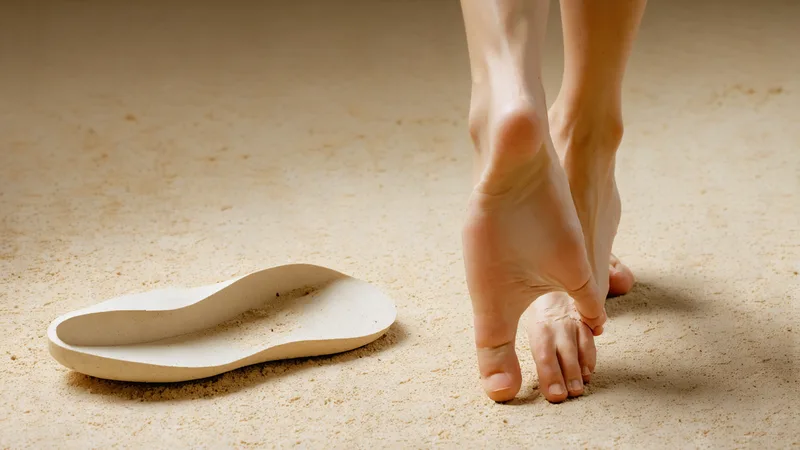
The midsole question sits at the centre of everything we do. Every millimetre of material between the foot and the ground is a design decision — not a default, not a standard, not a concession to comfort that somehow doesn't count. When we are working on a new sole configuration, the number we return to most often is not weight or durability or cost. It is: what does this layer cost us in terms of what the foot can feel?
Why the question is harder than it looks
The instinctive answer to "how much midsole is too much" is "as little as possible." But that answer is incomplete, and following it without qualification produces shoes that are uncomfortable on hard urban surfaces for most wearers. The real question is: what is the minimum thickness that provides adequate protection from acute plantar stress on the surfaces this shoe will actually encounter, while preserving the tactile information that makes ground-feel meaningful?
Those two requirements pull against each other in a non-linear way. Research into plantar pressure and tactile acuity suggests that the relationship between material thickness and sensory signal degradation is not a straight line. There appears to be a relatively permissive range in which added thickness has modest effect on ground feedback, followed by a steeper drop-off at a certain threshold. The practical question for us has always been: where is that threshold, and what moves it up or down?
The anatomy of signal loss
Ground feedback reaches the brain through two primary channels. The first is mechanoreceptors in the plantar surface of the foot — principally Meissner's corpuscles, which respond to light touch and texture, and Pacinian corpuscles, which respond to vibration and pressure changes. The second is proprioceptive input from the muscles and joints of the foot and ankle, which register load distribution and ground angle in real time.
Midsole material affects these channels differently. For mechanoreceptors, what matters most is whether the material deforms enough under foot pressure to transmit surface texture variation upward through the sole stack. A very compliant material at two millimetres can transmit more texture information than a very stiff material at the same thickness, because the stiffer compound averages out micro-surface variation rather than conforming to it. This is part of why sole compound matters as much as sole thickness in our design work.
For proprioceptive input, what matters is whether the foot can respond naturally to changing load — whether the intrinsic muscles can activate and adjust, or whether the material beneath them is doing the adjustment on their behalf. A soft, energy-returning midsole removes proprioceptive challenge by smoothing out load variation. This is the mechanism by which cushioned shoes reduce intrinsic muscle activation over time, and it begins to operate well below the stack heights that most conventional footwear uses.
What our testing found
We have run internal testing with our own wearers and runners over the past two years, varying midsole thickness and compound across otherwise identical shoe configurations. We are cautious about overstating what this kind of testing can establish — it is not a controlled study, and the sample sizes are small. But the pattern is consistent enough to inform our design choices, and I think it is useful to describe.
At zero to two millimetres of sole material, wearers consistently report high tactile acuity but also high sensitivity to acute pressure points — small stones, pavement seams, metal drain edges. Foot fatigue on hard surfaces extends beyond one hour of continuous use for most people, particularly those new to minimal footwear. The intrinsic muscle activation in this range is high and, over time, produces measurable strength gains. But the initial discomfort is a genuine barrier.
Between two and five millimetres, the reported experience changes noticeably. Acute pressure sensitivity decreases. Most wearers can cover hard urban surfaces for two or more hours without fatigue from ground hardness. Crucially, texture discrimination and proprioceptive engagement remain largely intact at this thickness, provided the sole compound remains compliant rather than stiff. This is the range we consider most useful for everyday and moderate-distance running applications.
Above roughly eight to ten millimetres, the feedback profile changes qualitatively. Wearers begin to describe the ground as "distant" rather than present. Proprioceptive response time slows, muscle activation patterns shift toward larger stabilisers at the expense of intrinsic function, and the kind of automatic gait refinement that minimal running produces begins to be suppressed. This is not a sharp threshold — individual variation is considerable — but the direction is consistent.
Compound as the underrated variable
Most discussions of minimal footwear focus on stack height. In our experience, the compound used in the sole is equally significant — and more often overlooked. A five-millimetre natural rubber sole at Shore A 50 transmits substantially more ground information than a five-millimetre EVA foam sole at the same nominal thickness, because the rubber conforms more closely to surface irregularities under load while the foam rebounds toward its resting state, averaging out what the foot is trying to read.
This is a key reason why we use natural rubber outsoles and minimise or eliminate EVA foam from our constructions. The difference is not mainly about durability or environmental considerations, though both matter. It is about what the sole is doing at the moment of ground contact. Rubber that gives slightly under pressure is transmitting information. Foam that springs back under pressure is filtering it.
The tradeoff is weight and cost. Natural rubber at the thicknesses we use adds meaningful grams compared to an equivalent EVA construction, and the material costs more. We think this is the right tradeoff, but we want to be clear that it is a tradeoff, not a free upgrade.
Where this leaves our design targets
Our current Arc Runner uses a three-millimetre natural rubber outsole with no additional midsole layer — a total stack of three millimetres at the forefoot. The Urban Flat uses a five-millimetre construction to provide adequate protection for all-day walking on city surfaces. The Trail Glider uses a four-millimetre construction with a more aggressive lug pattern that improves ground feel on unpredictable terrain by increasing the surface area of contact at each lug.
These numbers are not final. We revise them with each generation based on what we learn from the people who wear the shoes in real conditions. What they tell us, consistently, is that the ground feedback they value is present at these thicknesses — present in a way that it is not at the thicknesses conventional running shoes use. The goal is not a number. The goal is a relationship between the foot and the ground that the shoe does not interrupt. The numbers are just the instrument we use to measure how well we are achieving it.