
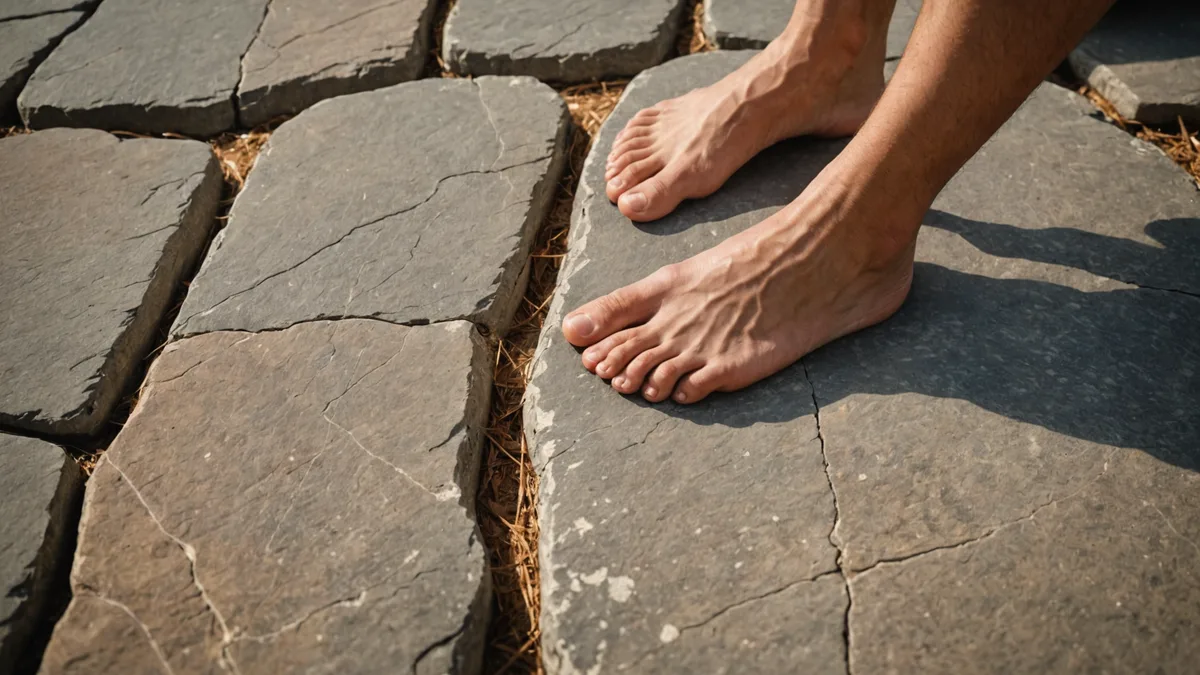
The human foot is not a passive structural platform. It is a sensory organ — one of the most densely innervated surfaces of the body, carrying somewhere in the range of 200,000 nerve endings in its plantar surface, organized in a distribution that maps closely to the mechanical demands of bipedal movement. The heel carries high-pressure sensors tuned to impact detection. The metatarsal heads carry sensors responsive to texture and shear force. The toe pads carry fine-pressure receptors capable of detecting surface features at the millimeter scale.
All of this sensory apparatus transmits continuously to the central nervous system during gait, contributing to what is technically called plantar mechanoreception — the detection of mechanical events at the sole of the foot — and to the broader system of proprioception: the body's awareness of its own position, movement, and loading state in space.
Thick-soled footwear attenuates this signal. The question worth asking carefully is: how much does that attenuation matter, and for what?
The mechanoreceptors: what they are and how they work
The plantar skin contains four primary classes of mechanoreceptors, classified by their receptor morphology and response characteristics. Meissner corpuscles, located in the superficial dermis primarily at the heel and toe pad regions, are rapidly adapting receptors sensitive to light touch and skin movement — they fire at the onset and offset of contact rather than continuously, making them particularly relevant for detecting surface transitions and texture changes. Merkel discs, distributed more uniformly across the plantar surface, are slowly adapting receptors that respond to sustained pressure and edge detection — the kind of information that tells you the shape and hardness of what you're standing on.
Pacinian corpuscles, found deeper in the dermis and in the periosteum of foot bones, detect vibration and rapid deformation — they're sensitive to the impact transients of heel strike and respond to vibration frequencies in the range of 200 to 300 Hz, which corresponds to the kind of vibratory signal that propagates through compact ground surfaces. Ruffini endings respond to skin stretch, particularly at the toe dorsum, contributing to information about toe splay and joint angle.
Together these receptors create what biomechanics researchers describe as a multi-dimensional sensory field at the ground interface. The signal they generate feeds into spinal reflexes and cortical processing pathways that contribute to postural control, balance correction, and gait adjustment — often at latencies too short for conscious involvement.
What cushioning actually filters
A foam midsole between the foot and the ground functions as a low-pass mechanical filter. High-frequency vibration components — the surface texture signal, the fine-grain impact transients — are attenuated first. Lower-frequency signals associated with gross loading magnitude and gross slope information pass through more intact.
Research in the field of footwear biomechanics has measured this filtering effect in various ways. Studies using vibrotactile thresholds — the minimum vibration amplitude detectable by the plantar surface — find consistently elevated thresholds in subjects wearing cushioned soles compared to thin soles or bare feet. The effect scales roughly with midsole thickness: a 20mm EVA midsole produces substantially more attenuation than a 5mm TPU plate.
What this means practically is that a runner or walker in conventional cushioned footwear receives a degraded version of the terrain signal. They can detect gross features — the difference between pavement and grass, significant slope changes, large obstacles — but the fine-grain texture and vibration information that the plantar mechanoreceptors are designed to capture is largely filtered before it reaches them.
We're not saying this is catastrophically harmful in all contexts. Cushioning was developed to solve a real problem — impact reduction for heel-strike running on hard surfaces — and it does that. The attenuation of proprioceptive signal is a side effect, not the design intent. But when we ask what NEULO's thin natural rubber sole does differently, the answer begins here.
Proprioception and ankle stability
The strongest evidence for the functional significance of plantar proprioception comes from ankle sprain research. Ankle inversion sprains — the most common acute injury in running and field sports — occur when the foot is suddenly loaded in a position that the ankle's passive stabilizers (ligaments) cannot accommodate. The joint's active stabilizers (peroneal muscles) must respond quickly enough to prevent or limit the sprain. Speed of response matters enormously: the window between the onset of inversion and ligament injury is typically measured in tens of milliseconds.
Studies examining what factors predict peroneal response latency find, among other variables, that plantar sensory input is a significant contributor. The reflexive activation of peroneal muscles in response to sudden inversion events is faster when plantar sensory input is richer. Footwear that attenuates plantar sensation increases the signal-to-noise challenge for this reflex pathway.
Several research groups have examined this specifically in the context of footwear thickness. The general finding, replicated across studies with varying methodologies, is that thinner soles produce faster ankle reflex responses to perturbation than thicker soles — with barefoot performance generally fastest. The mechanism is consistent with the mechanoreceptor story: better input, faster reflexive response, reduced injury window.
This does not mean that thin soles always produce better ankle stability outcomes. The tissue adaptation issue is important here: someone transitioning too quickly to minimal footwear may have worse ankle stability than in their previous shoes, because the stabilizing muscles haven't yet been conditioned. The proprioceptive advantage of a thin sole only fully manifests once the neuromuscular system is trained to use the information it receives.
What the research does and doesn't say about injury
The question people most often ask about proprioception and footwear is whether this mechanism explains injury patterns — specifically whether conventional cushioned shoes, by attenuating proprioceptive signal, increase injury risk. The honest answer is that the evidence is suggestive but not conclusive, and the relationship is complicated by confounders that are difficult to control in real-world studies.
Prospective injury studies comparing minimalist and conventional footwear populations produce inconsistent findings. Some show lower injury rates in minimalist groups; others show higher rates, particularly in the transition period; others find no significant difference when controlling for running experience and transition protocol. The interpretation challenge is that runners who choose minimal footwear may have different baseline foot strength, training habits, and biomechanical profiles than those who don't — making it difficult to isolate the footwear variable.
What the mechanistic evidence supports more clearly is this: the plantar surface is a sensory input pathway that contributes to movement regulation, and that pathway is substantially attenuated by conventional footwear. The hypothesis that this attenuation has functional consequences for movement quality and injury risk is biologically plausible and mechanistically grounded. The magnitude and clinical significance of those consequences for the general population of shoe wearers remains less certain.
Sensory acuity and the aging foot
There's an additional dimension to this that the running-focused discussion often misses: the age-related decline in plantar mechanoreceptor function. Vibrotactile thresholds in the plantar surface increase with age — the receptors become less sensitive, the signal-to-noise ratio degrades — and this decline has been linked to postural instability and increased fall risk in older adults. Balance board studies consistently show that older adults benefit more from barefoot or thin-sole conditions than younger adults, because the marginal sensory gain from footwear removal is larger for a population with reduced baseline sensitivity.
This suggests that the value of preserving and training plantar sensory function may compound over time — that the foot kept engaged with accurate ground feedback over years maintains its acuity better than one that has spent decades receiving filtered signals. This is a long-horizon argument and one we cannot currently verify with longitudinal data. But it's consistent with what the mechanoreceptor biology suggests.
What the thin sole does at NEULO
The natural rubber outsoles on NEULO's shoes measure between 4mm and 6mm at the forefoot, depending on the model. They transmit surface texture, vibration, and ground compliance information that a conventional 15 to 20mm midsole would attenuate. They do not transmit the full barefoot signal — no shoe can — but they operate closer to the barefoot end of the spectrum than most footwear.
This is not incidental to the shoe's design. The proprioceptive channel was a primary consideration in choosing the outsole thickness and material. Natural rubber at this thickness has transmission properties that synthetic foam compounds at similar thickness don't match — the rubber's elasticity preserves more of the mid-frequency information that foam absorbs. It's one of the reasons we use natural rubber despite its higher cost and more demanding processing requirements.
The sensory richness that comes with a thin sole is partly why the transition to NEULO shoes requires time and adaptation. The foot is receiving more information than it is accustomed to processing, and the nervous system takes time to calibrate its response to that input. The initial sense of unfamiliarity — the heightened awareness of the ground — settles into competence. The foot learns to use what it's reading. That learning is the process we're trying to support.