
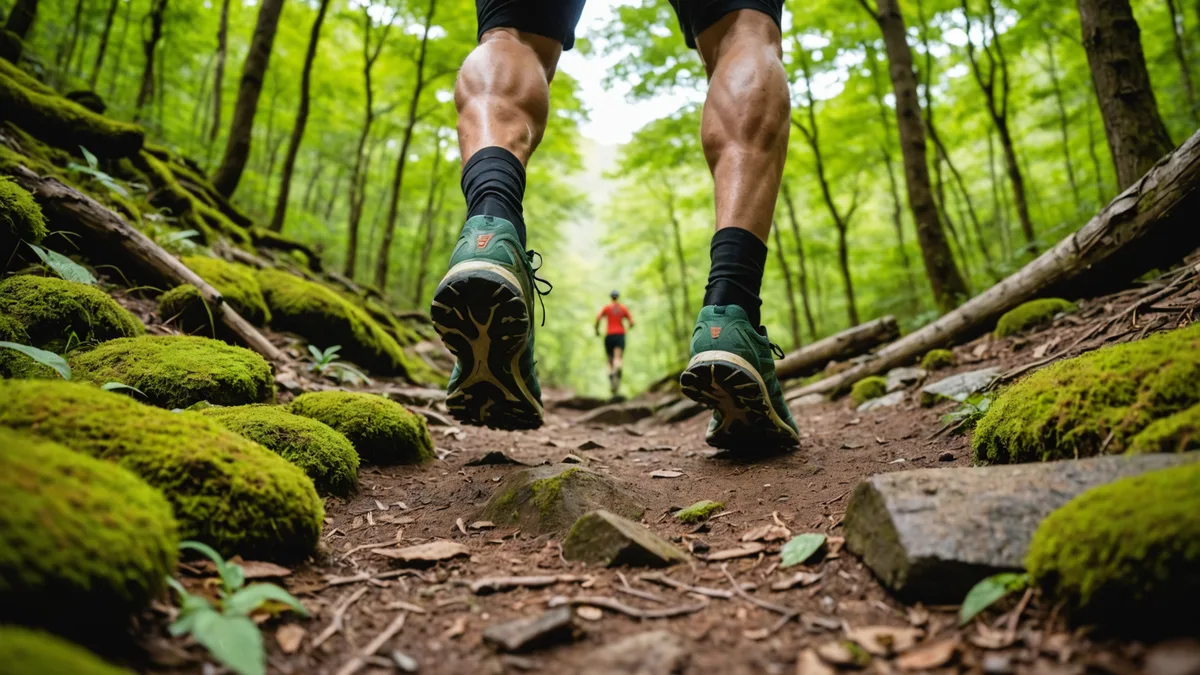
The first time I ran a serious stretch of trail in what became the Trail Glider prototype, I was on the western ridgeline of Okutama, about ninety minutes from Shinjuku station by train. The trail there — connecting the Mitake area down toward the Tama River — is good test terrain: some compact earth, some exposed root networks, occasional wet rock where the canopy stays dense, a few short technical descents. Not extreme, but honest.
I had been running in minimal footwear on roads for several years before this. Trail was different. I knew it would be different in theory. The experience of that first long session made the difference concrete in ways I want to try to describe accurately, because I think some of the common descriptions of minimal trail running — both from enthusiasts and skeptics — miss what actually changes.
What changes immediately: foot placement
The first and most obvious change is where your eyes go. On road, minimal footwear quickly teaches midfoot strike and cadence adjustment, but the visual demand is low — pavement is uniform, and once the gait pattern is established you can think about other things. On trail, you're reading terrain constantly, several steps ahead, making micro-placement decisions at a rate that road running doesn't require.
In conventional trail shoes with thick midsoles, some of that reading is done passively by the cushioning — the shoe absorbs irregular surfaces without requiring foot placement precision. In minimal shoes, the foot needs to be placed more intentionally. On rock, you want flat foot contact rather than landing on a sole edge. On root crossings, you want the ball of the foot rather than the arch. On wet earth, you want to feel the grip before committing weight.
This is not harder in a pejorative sense. It's more demanding of attention. Most people who trail run in minimal shoes describe eventually finding a state of elevated focus that feels qualitatively different from padded shoe running — the trail as conversation rather than obstacle course. But the first several sessions require deliberate, effortful attention that can be tiring in itself, independent of cardiovascular load.
What the terrain feedback actually tells you
The plantar surface of the foot contains a high density of mechanoreceptors — sensory nerve endings responsive to pressure, texture, vibration, and deformation rate. In standard trail footwear, much of this signal is attenuated by foam. The foot receives a simplified version of the terrain: soft, hard, slope, slope direction. In minimal shoes, the signal is fuller.
The practical effect is that you begin to distinguish surface types through feel — compressed earth versus loose earth, wet rock versus dry rock — and the body makes postural adjustments in response to this information faster than conscious thought. The slight widening of stance on a loose surface, the weight shift forward on a wet descent, the grip-seeking toe extension on rock: these happen before you've decided to do them.
On the Okutama ridge descent, there's a section of exposed granite that gets polished and slick after rain. In the Trail Glider prototype, I could feel the transition from earth to stone through the sole — not the sensation of standing on rock directly, but the change in texture information was clear enough to prompt a slower, more deliberate placement. In padded trail shoes, I've gone over that section faster and more confidently, and also slipped twice. The minimal shoe's response is more cautious but more informed.
What improves, and on what timeline
The improvements in trail running with minimal shoes are real but not immediate. They require the same kind of tissue preparation I'd recommend for road running, plus additional proprioceptive conditioning. For someone already adapted to minimal footwear on roads, the trail transition typically takes four to eight weeks of regular trail running before the movement patterns become automatic.
What improves first is balance and lateral stability. Because the foot is in direct relationship with the terrain, and because the ankle isn't riding on a thick midsole that can roll unpredictably on irregular surfaces, the foot-ankle-calf complex becomes more responsive and reliable. People who have run in cushioned trail shoes often report that their first experience with minimal trail shoes is paradoxically more stable on technical terrain — not less — because the contact information is more accurate.
What improves more slowly is the ability to sustain longer efforts without fatigue in the intrinsic foot muscles and calf. The Achilles and posterior tibialis work harder in minimal trail shoes, particularly on descents. This is honest work — these structures are doing what they're built to do — but they need to be conditioned to the volume. Running a 15-kilometer trail in minimal shoes the first time you try trail running this way will hurt the day after in ways you won't forget. The calf fatigue in particular can be significant.
What hurts first, and whether that's a problem
Let me be direct about this: the transition to minimal trail running involves soreness. The question is whether the soreness is adaptation or injury, and that distinction matters.
Adaptation soreness presents as: diffuse calf aching, arch fatigue that resolves fully with rest, general foot muscle tiredness. This is normal. It's the same mechanism as starting any strength training program — you're loading structures that haven't been systematically loaded, and they respond by adapting. Forty-eight hours after a hard minimal trail session, the soreness should be receding, not intensifying.
Injury signals are different: sharp heel pain, particularly at the Achilles insertion or under the calcaneus. Pain that localizes precisely rather than diffusing across the foot or calf. Pain that intensifies with continued activity rather than warming up. If these appear, the progression has moved too fast. Walking back to easy terrain and lower volume is not failure — it's the correct response to tissue that needs more time.
We're not suggesting that trail running in minimal shoes is risk-free or appropriate for everyone. People with existing Achilles tendinopathy or significant intrinsic foot weakness should take longer preparation timelines, and some should consult with a sports physiotherapist before beginning a transition. The shoes don't override anatomy.
The thing about technical descents
Downhill running in minimal trail shoes deserves specific mention because it's where conventional wisdom about minimal footwear and trail running is most often wrong in both directions.
The concern is rock bruising — that without cushioning, sharp rock impacts on the ball of the foot become painful or damaging. This is a real concern on sharp, loose scree. On the compact trail terrain that defines most accessible Japanese mountain running — the Okutama system, the Tanzawa range, the lower ridges of Chichibu — it's rarely an issue in practice. The terrain is mostly rounded or embedded rock, not loose sharp edges, and forefoot-biased contact distributes load differently than heel-strike landing.
The less expected challenge of technical descents in minimal shoes is braking force. In cushioned shoes, heel-strike landing on descent functions as a braking mechanism. In minimal shoes, heel landing is uncomfortable and quickly self-corrects to forefoot or midfoot — but that means the quads, not the heel, absorb braking load. Quad fatigue on long descents is real and catches people by surprise. It's another reason the volume should be built gradually: the movement pattern shift is easy to make, but the muscular demand of the new pattern takes time to accommodate.
The Okutama ridgeline, end of a four-hour day: the descent was slow because the quads were done. But the feet were fine, and my reading of the terrain — wet root, loose stone, angle of the slope — felt sharper at hour four than hour one. That's the promise of minimal trail running, and on that particular day it held.