
When I first started seriously researching conventional shoe manufacturing, I expected the materials story to be complicated. It turned out to be more complicated than I expected. A typical mass-market canvas sneaker, from cotton field to finished product, passes through somewhere between 30 and 50 distinct chemical treatments — many of them entirely invisible in the final shoe, most of them documented nowhere on the product or its packaging.
I'm not writing this to be accusatory about conventional manufacturing. Those processes exist for reasons: color uniformity, surface durability, moisture resistance, appearance consistency across large production runs. They solve real problems. The question we asked when developing NEULO's materials was not whether those processes make sense for mainstream footwear, but whether they make sense for what we're making — and, specifically, whether the properties they create are properties we actually need.
What conventional canvas processing looks like
Cotton canvas, before any footwear-specific treatment, typically begins its industrial life with a scouring process — alkaline baths, often at 90°C or above, to remove natural waxes, pectins, and seed residue from the fiber. This is followed by bleaching, usually with hydrogen peroxide or chlorine-based compounds, to achieve a white or near-white base for subsequent dyeing. Even canvas that appears off-white in a finished shoe has often been bleached to a uniform starting point before being tinted back toward natural tones.
After bleaching comes sizing — the application of starch, polyvinyl alcohol, or other compounds to the yarn to add stiffness for weaving — and then desizing after weaving is complete. Then mercerization for cotton strength and dye uptake. Then dyeing itself, often using reactive dyes with metal-complex fixatives. Then washing, neutralizing, softening agents, optical brighteners, water repellents (often per- and polyfluoroalkyl compounds in conventional applications), anti-microbial finishes, stain guards. Some canvas upper materials also receive a film coating applied by padding or knife-over-roll that adds surface uniformity but significantly reduces breathability.
By the time a canvas upper arrives at a shoe factory, the material it's made from shares little chemistry with the cotton plant it grew from.
The six processes we kept
When we mapped what NEULO's upper material actually needs to do — be structurally stable for lasting, dimensionally consistent, breathable against the skin, durable at high-flex points, and honest about its aging — we arrived at a much shorter list.
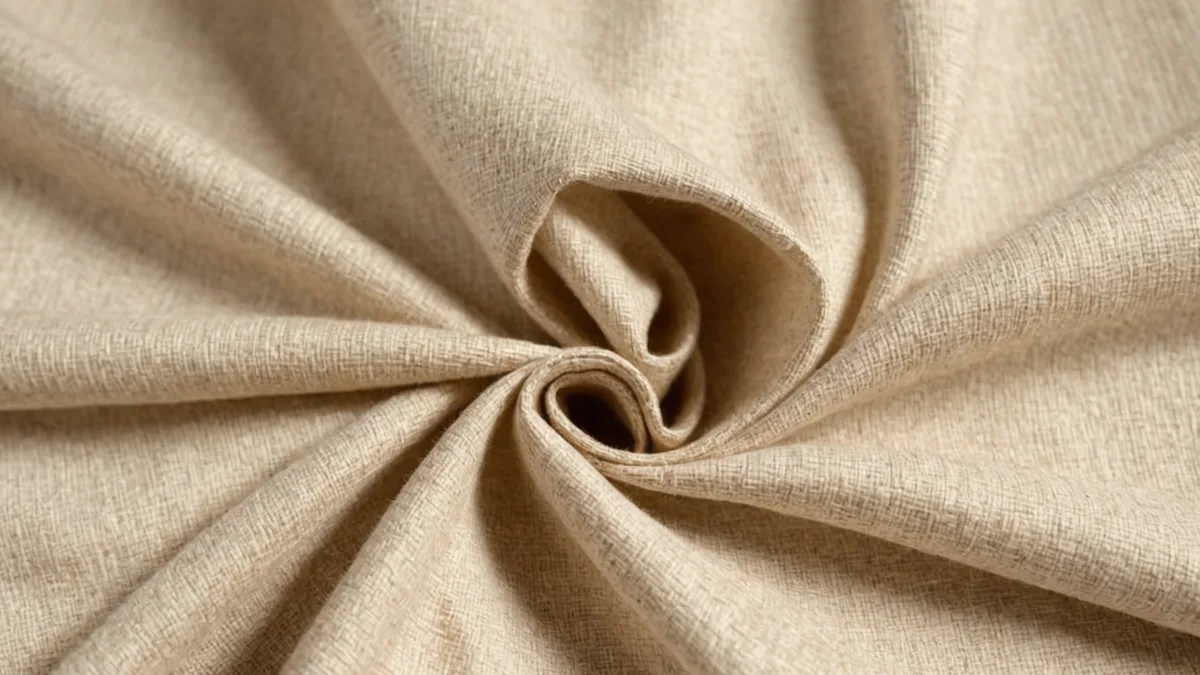
We use a natural-tone canvas that has been scoured but not bleached. The scouring removes processing contaminants but preserves the natural color variability in the cotton — what reads as the warm, slightly irregular cream tone of our uppers. This is not bleached and tinted back. It's the cotton's actual color after basic cleaning.
The canvas is pre-shrunk before cutting. This is mechanical rather than chemical — the fabric is relaxed through tension cycling with heat and moisture, which sets dimensional stability without applying chemical stabilizers. It's a slower process but leaves no chemical residue.
At the construction stage, we use a water-based adhesive at the lasting margin — a polyurethane-based formula without organic solvents. Solvent-based adhesives are common in shoe construction because they bond faster and with less surface preparation, but they off-gas during application and remain detectable in the finished shoe for months. The water-based alternative requires more careful surface preparation and longer curing time. We accept the slower process.
The thread we use at structural seam points — the toe cap seam, the lasting margin stitch — is a natural cotton thread treated with a light beeswax application for friction resistance during sewing. This is a pre-industrial technique that still works, and it doesn't introduce synthetic chemistry into the stitching.
That accounts for four treatments. The remaining two are the rubber vulcanization process for the outsole and a final quality wash of the finished shoe before inspection. The rubber vulcanization is unavoidable — it's what converts natural rubber latex from a raw to a durable state — and it's the single most chemically significant step in our production process.
What we eliminated and what it cost us
The most significant elimination was water repellent treatment. Most canvas footwear receives a durable water repellent (DWR) coating, historically applied as a fluoropolymer finish. PFAS-based DWRs are under increasing regulatory scrutiny in the EU and, at a slower pace, in Japan. Their environmental persistence is well-documented. We chose not to use any DWR — fluoropolymer or alternative — on the upper.
The trade-off is real: NEULO canvas uppers wet out in the rain. The canvas absorbs moisture rather than beading it. This dries reasonably quickly — the canvas breathes well enough that a wet shoe is usually functional again within a few hours in normal conditions — but we're not going to tell you it's equivalent to a DWR-treated surface. It isn't. If you're running in sustained rain, your feet will be wet.
We eliminated anti-microbial finish treatments as well. These are applied in many athletic shoes to reduce odor-causing bacteria in the upper. Our approach instead relies on the natural bacterial-resistance properties of the sole construction — the rubber and the absence of synthetic foam insole layers reduces the warm-damp environment that aerobic bacteria favor — and on the expectation that the shoes will be worn with normal foot hygiene. This works in practice for most wearers. It requires more attention to drying after wet use than a chemically treated shoe does.
We also did not apply any stiffening finish to the outer upper surface. Conventional canvas uppers are often lightly resin-coated to maintain surface smoothness and prevent soiling. NEULO's upper will develop surface texture and visible flexion creases with wear — the material reflects use. This is intentional, not an oversight. But it does mean the shoes look different at six months than they did at purchase.
Why this matters for skin contact
A shoe upper is in contact with the skin of the foot for hours at a time. The foot is one of the body's significant areas of transdermal absorption — the dense vascular network in the plantar fascia and dermal layers means that substances in prolonged skin contact can enter circulation at meaningful rates, particularly under the heat and perspiration conditions of active wear.
We're not claiming that conventional shoe chemistry causes harm at typical exposure levels. The evidence on footwear-specific dermal exposure to finishing chemicals is genuinely limited. What we are saying is that the precautionary case for reducing unnecessary chemical treatments in a product worn for hours at a time seems reasonable to us. Choosing not to apply treatments you don't need is a different calculation than choosing to apply treatments that have known risks.
The unbleached canvas choice is partly about aesthetics — we find the natural material tone more honest — and partly about this precautionary calculation. A material that hasn't been bleached, re-dyed, resin-coated, or water-repellent-treated is simpler chemistry in contact with the skin. That seems right for a shoe designed to be worn close to the body's ground interface.
The limitations of this approach
We should be clear about what reduced chemical processing does not solve. The cotton itself is grown somewhere, and the environmental footprint of cotton cultivation — water intensity, conventional pesticide use in non-organic cotton — is a separate and significant question from the processing we've described. We currently source from a supplier whose fiber comes from certified reduced-pesticide cultivation in Japan and neighboring regions, but we're not claiming certified organic status and we won't until we can verify the supply chain with more precision than we currently have.
The rubber outsole, as mentioned, requires vulcanization, and the sulfur-based vulcanization chemistry is not something we've found a workable alternative to at the quality level we need. Natural rubber has significant environmental advantages over petroleum-derived synthetic rubbers, but natural rubber vulcanization is still a chemical process with its own waste stream considerations. We're not presenting our materials as chemically simple from field to finished shoe. We're presenting them as simpler than the industry baseline, and attempting to be honest about where the simplification stops.