
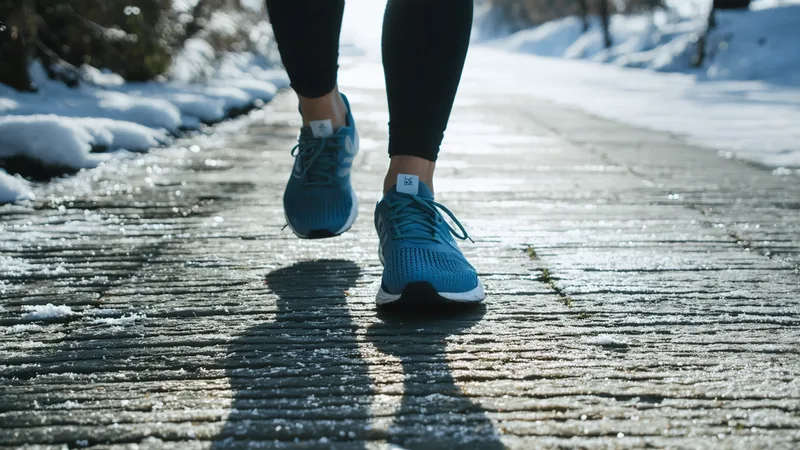
Every December, we get the same question. People who have run through a Tokyo summer in minimal shoes, who have felt the morning asphalt through a three-millimetre sole, who have started to understand what ground feedback actually means — they write to ask whether they have to stop when the temperature drops. The honest answer is no. But winter in minimal footwear requires a different kind of attention, and I want to describe exactly what that means.
What cold ground actually does to your feet
Cold affects the foot in two distinct ways that are worth separating. The first is thermal: below roughly eight degrees Celsius, peripheral circulation to the extremities begins to reduce as the body conserves core heat. The second is mechanical: cold stiffens the plantar fascia, the intrinsic foot muscles, and the connective tissue around the ankle. These are separate problems that require separate solutions.
The thermal problem is largely handled at the sock layer. A merino wool liner — not a thick padded sock, which defeats the purpose of a thin sole — keeps circulation moving without adding meaningful material between foot and ground. The mechanical problem is handled through warm-up protocol. We spend more time than feels reasonable on dynamic foot preparation before winter runs: toe spreads, heel raises, slow ankle circles. The tissue needs to be pliable before it meets the cold pavement at pace.
What cold ground does not do is eliminate ground feedback. If anything, the sharpness of a cold surface heightens tactile awareness. The issue is that the body's protective response — pulling the foot back from cold contact — can disrupt the natural landing pattern that minimal running depends on. This is the tension we are managing.
The temptation to add cushioning and why we resist it
Every winter, the cushioned-shoe industry produces articles explaining that cold weather justifies more stack height. The reasoning sounds practical: more material between your foot and the frozen ground means less thermal transfer, less discomfort, more time outside. We understand the logic. We do not agree with the conclusion.
The problem is not that extra cushioning is uncomfortable. The problem is that it breaks a feedback loop your body has been building all summer. The landing mechanic you have developed — the forefoot contact, the reflexive adjustment to surface irregularities, the proprioceptive confidence — is built on a specific relationship between your sole and the ground. Interrupt that relationship for three months and you return in spring to rebuild it. We find it more useful to maintain the connection and manage the cold through other means.
That said, there is a reasonable middle position. A sole that is three millimetres in summer can become four or five millimetres in winter — a fraction more insulation without meaningfully changing the feedback profile. This is the adjustment we make in our cold-weather running configurations. Not cushioning. Just a slightly denser outsole compound that retains ground feel while reducing thermal transfer at sub-five-degree temperatures.
Traction, not cushioning, is the real winter concern
When we examine the actual running injuries that occur in winter, ice and wet stone contribute far more than cold-ground sensation. A minimal shoe with a flexible natural rubber outsole performs well on cold dry pavement. It performs unpredictably on black ice or polished stone made slick by rain and near-freezing temperature.
Our approach is to read the surface before committing to a stride. Tokyo winters are mostly dry and cold, not icy — but the first few mornings after a rainfall, or in the shade of tall buildings where frost lingers, demand different choices. We route around those sections. We shorten stride length and widen base width when we cannot. We accept that some mornings, the route changes.
The natural rubber compound we use in our outsoles maintains grip characteristics down to about minus five Celsius before it begins to harden meaningfully. Below that temperature, which happens perhaps six or seven mornings a year in Tokyo, we reduce pace and increase caution rather than switching shoes.
Socks, liners, and the layering question
We have tested most of the available thin running sock options over the past two years. The consistent finding is that merino wool at ten to fifteen percent of total sock construction makes a significant difference in thermal performance without changing the fit profile inside the shoe. Synthetic materials that claim equivalent warmth typically achieve it through added bulk, which moves the foot forward in the last and changes the flex point relationship.
A toe-sock design also helps in cold conditions for a specific mechanical reason: separated toes maintain independent movement and blood circulation better than toes compressed together in a conventional sock. The wide toe box in our shoes accommodates this naturally. In winter, we tend to wear toe socks more consistently than in other seasons precisely because the thermal benefit compounds with the movement benefit.
What we do not recommend is double-socking — wearing one thin sock over another. The shear between the two layers creates friction points at different locations than a single sock would, and the cumulative thickness changes the shoe fit enough to introduce the kinds of pressure points that cause blisters on longer runs.
How to read your feet during a winter run
In warmer months, the feedback from a minimal sole is rich enough that you rarely need to consciously interpret it. You feel the ground and respond. In winter, it is worth developing a brief check-in practice at the ten-minute mark of a run. By then, the foot is either warming up into normal function or it is telling you something useful about the conditions ahead.
What you are looking for: first, whether you have maintained your natural landing pattern or shifted to a more heel-dominant stride as a cold-ground protection response (this is common and worth correcting through awareness rather than ignoring). Second, whether the intrinsic muscles are engaged or whether your toes are curling defensively — another cold response that over time compresses the toe box unnecessarily and changes gait.
The best signal that a winter run is going well is not comfort. It is that you have stopped thinking about the cold and started paying attention to the run itself. That transition usually happens somewhere between the eight and fifteen minute mark, depending on temperature. Until it happens, slow down and let the body settle.
The longer view
We have been running minimal through Tokyo winters for several years now. The honest assessment is that the transition from summer to winter running takes about two weeks of recalibration each year — shorter if you have maintained consistent movement practice, longer if you have been off your feet. The sensory relationship between a thin sole and cold ground is genuinely different from warm-ground running, and it takes the nervous system a short time to update its expectations.
What we value about winter minimal running is that it asks more of you. The attention required to read cold surfaces, to warm up properly, to pace yourself through the first cold kilometres — this is not a burden. It is the practice reminding you that it is a practice. Summer running in minimal shoes can become automatic. Winter running keeps you present.
That quality of presence is what we are trying to build into the shoes themselves. The cold months simply make it impossible to forget.